
Hyaluronic acid fillers placed with surgical precision — restoring volume and refining facial proportions. Performed by Dr. Rajesh Vasu, AIIMS-trained plastic surgeon. 30-minute walk-in procedure. No general anaesthesia. No downtime.
30 minutes
Topical numbing
Visible immediately
9–18 months
Same day, immediate return to work
Dermal fillers are gel-like substances — most commonly hyaluronic acid, a sugar molecule that occurs naturally in your skin — injected beneath the surface to restore lost volume, smooth lines, or refine facial proportions. Hyaluronic acid fillers are reversible — if you change your mind or want adjustment, an enzyme called hyaluronidase dissolves them. Results are visible immediately and last 9–18 months depending on the area and product used.
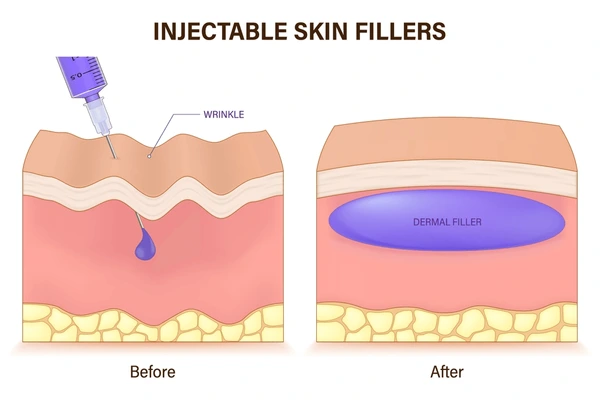
The face loses volume with age — fat pads shrink, bone structure subtly recedes, and skin becomes less supportive. The result is hollowing in the cheeks, shadows under the eyes, deepening lines around the mouth, and overall flattening of facial structure. Targeted dermal filler placement restores that volume — not by changing your face, but by returning what’s been lost.
Restores the projection and definition of the mid-face that’s lost with age or that some patients are born with less of. Lifts the cheekbone area, supports the under-eye, and softens nasolabial folds indirectly.
Typical volume: 1–2 ml per side. Lasts 12–18 months.
Treats the hollow shadow that develops under the eyes — making patients look tired even when well-rested. The most technique-sensitive area on the face — millimetres of placement matter. Typical volume: 0.5–1 ml per side. Lasts 9–12 months.
Softens the lines from the nose to the corners of the mouth. In most cases, deep nasolabial folds are caused by mid-face volume loss — which is why we often treat the cheek first, and the nasolabial fold itself only secondarily.
Typical volume: 0.5–1 ml. Lasts 9–12 months.
Treats the downward lines that form from the corners of the mouth toward the chin, often making the face look sad or tired.
Typical volume: 0.5–1 ml. Lasts 9–12 months.
Restores volume to the temples — a subtle but high-impact treatment that lifts the upper face and opens up the eye area.
Typical volume: 1 ml per side. Lasts 12–18 months.
Most patients combine 2–3 zones in a single session for a balanced result. Treatment plan is mapped at consultation based on what your face has actually lost — not against a generic template.
Not every filler is about restoring something lost. Many patients use fillers to refine proportions they’ve always had, or to define features that didn’t develop fully. These are non-surgical alternatives to procedures that would otherwise require surgery.
Dr. Vasu examines your face in motion. Photographs taken. Treatment zones marked. Filler type and volume confirmed with you.
Topical numbing cream applied. Most fillers also contain lidocaine, which numbs the tissue as it's injected.
Precise placement of filler at the marked points using a needle or cannula depending on the area. Most patients describe it as a small pinch and pressure.
Mild swelling and possibly small bruising at injection sites — both settle in 24–72 hours. Aftercare instructions, ice if needed. You leave the clinic and resume normal life.
Most patients see immediate results, with minor swelling that settles over 2–3 days. The “final” result — once swelling resolves — is visible by day 3–5.
Most patients see immediate results, with minor swelling that settles over 2–3 days. The “final” result — once swelling resolves — is visible by day 3–5.
Performed in a fully accredited tertiary care hospital — sterile theatre, advanced infection control, hospital-grade safety standards. Not a clinic room.
Performed personally by Dr. Vasu. No technicians, no junior staff, no routing through general practice. Plastic surgery technique applied to every repair, however small.
30+ years of clinical experience. 5,000+ procedures performed. Internationally trained in aesthetic surgery at one of Europe’s most respected institutes.
Real patients. Real repairs. All photographs published with written consent.

Patient 1 · Female, 34 3 months post

Patient 2 · Female, 34 3 months post

Patient 3 · Female, 34 3 months post
Individual results vary. Photographs are representative, not guaranteed outcomes. Consultation required to assess suitability.
Real patients. Real repairs. All photographs published with written consent.

 Uzzal Buragohain
Trustindex verifies that the original source of the review is Google.
My mother underwent ankle surgery, following which she developed a wound infection with exposure of the tendon. We consulted Dr. Rajesh Vasu for management of the infected wound. After a thorough examination, Dr. Vasu advised a staged treatment plan. The first procedure involved surgical debridement and thorough cleaning of the infected wound, followed by application of a VAC (vacuum‑assisted closure) machine to prevent further infection and promote healing. Once the wound was adequately cleaned and the infection was controlled, Dr. Vasu explained that application of Dermacell was necessary to ensure faster and proper wound healing. Accordingly, Dermacell was applied as the second stage of treatment, and the VAC machine was reapplied. Finally, after completion of these procedures, Dr. Vasu performed skin grafting surgery to achieve complete wound closure. My mother is recovering well, and I am very thankful to Dr. Rajesh Vasu, Dr. Astha, Satheesh, and the entire medical staff for their care, dedication, and support. Aneel KumarDr. Rajesh Vasu and his team Dr.Astha Sarda assisted by Deepika have done a thoroughly professional job of Sebaceous cyst execion surgery in a blemish free manner, and I am fully satisfied and happy with their job. I recommend the team and Apollo Hospital, Nanakramguda, for those trying surgical interventions for their problems without hesitation.
 VENI VGVery very excellent👍👍👍👍👍
 sreekanth damaDr. Rajesh Vasu is very experienced and professional. I underwent corn removal under his care, and the procedure was quick and well-handled. He explains everything clearly and makes the patient feel at ease. Recovery was smooth. Highly recommended.”
 Soumya Satish ShirurI have undergone surgery for divarication of recti as well as lipo , i had diastasis recti and a chronic back ache .. the surgery went well ,so far so good ... Dr. Rajesh vasu sir is renowned for his work, he is a man of his word, he explains everything so patiently and makes the patient feel positive,I was unaware that divarication of recti could be covered under insurance,he helped us through this . he helped me gain my confidence by getting me rid of my mommy pouch . I got the desired results and i am happy with the surgery , heartfelt thanks to him..
 Ratna UppuluriGot digital nerve repair surgery done for my son. Was provided recovery information in technical detail before surgery. Surgery was done without any hiccups. All reviews were very useful. 100% would recommend for hand microsurgery.
 ansh singhI underwent a tummy tuck and breast lift surgery at Apollo Hospitals, Financial District, under the care of Dr. Rajesh Vasu. From the very first consultation, I felt completely at ease with him. His calm and reassuring approach gave me the confidence to move forward, and I knew I was in safe hands. The entire experience at the hospital was truly commendable. The staff was extremely cooperative, attentive, and supportive throughout my stay. On the third day, I was feeling quite homesick and wanted to return home, but the staff patiently counseled me and convinced me to stay one more day for better recovery. I’m glad I listened to them. The surgery itself went very smoothly, and the results were visible immediately after I woke up. My recovery has been comfortable—I was on medication for a week, after which I didn’t feel the need to continue, as I experienced minimal pain. I am extremely happy with the results of my tummy tuck and breast lift procedures. I also underwent 360-degree liposuction, and as advised by the doctor, I understand that the final results will take some time to fully appear. I would also like to mention Dr. Vasu’s assistant, Deepika, who was incredibly helpful and supportive throughout the process. Everything was well-organized, and the hospital maintained excellent hygiene standards. I truly feel fortunate to have chosen Dr. Rajesh Vasu for my surgery. I am very happy with my experience and will be sharing a detailed review of my liposuction results once they are fully visible.
 Nanda Kumar PARASURAMUDUI have Suffering from unhealed vericose since years.. After meeting Mr. Rajesh Vasu.. Sir took much intrest and done grafting for that wound so, that vericose wound healed well now.. Sir is very friendly and deep going about the patient concern .. Helped me to move without a bandage ... Thank You sir... 🙏🙏🙏🙏
Yes — hyaluronic acid fillers are reversible with an enzyme called hyaluronidase, which dissolves the filler in 24–48 hours. This is one of the most reassuring properties of HA fillers and one reason they’re the dominant filler type in modern aesthetic medicine.
Not when dosed correctly. The modern approach is “less is more” — restoring proportion, not adding volume for its own sake. Most patients want to look refreshed, not different. Conservative volume, distributed correctly, is the rule at our clinic.
The injections themselves feel like small pinches, made comfortable by topical numbing and the lidocaine in most filler products. Tear trough and lip filler are slightly more sensitive areas. Most patients describe sessions as much more comfortable than they expected.
Bruising is possible but not certain — about 30% of patients have some bruising at injection sites that settles in 5–7 days. The likelihood is higher for tear trough and lip areas where the skin is thinner. Cannulas (instead of needles) reduce bruising in many cases.
Same day for most patients. Mild swelling is normal for 24–72 hours. If you have an important event, schedule your filler session at least 2 weeks ahead so any bruising or swelling has fully resolved.
We use FDA-approved hyaluronic acid fillers from authorised distributors. The specific product is matched to the area and your needs — different fillers have different properties
Botox relaxes muscles to soften lines caused by movement. Filler adds volume to restore lost tissue or define structure. They work on different anatomical layers and are commonly combined in a single appointment for a complete result.
Pricing is per syringe (usually 1 ml per syringe). Cost varies based on the filler product used and how many syringes your treatment plan requires.
Yes — and many patients do. Treating multiple zones in one session is often more efficient and produces a more balanced result than treating one zone at a time. Treatment plan is mapped at consultation.
Lip filler is covered separately because the technique, products, and outcomes are different from other facial filler. Read about lip filler in Hyderabad →
A consultation gives you clarity. Dr. Vasu assesses your face, discusses what’s possible, what isn’t, what it costs, and what to expect — honestly. You leave with enough information to make a confident decision, with no pressure to book the procedure that day.