
A hair transplant restores hair to areas where it has thinned or gone. The technique matters. The surgeon matters more. Performed personally by Dr. Rajesh Vasu, plastic surgeon, at Apollo Hospitals, Financial District. FUE and FUT techniques, both, with the choice made for you, not the other way round
4 to 8 hours per session
Local anaesthesia
5 to 7 days
9 to 12 months
A hair transplant takes hair follicles from the back and sides of your scalp (the donor area, where hair is genetically resistant to falling out) and places them in areas where the hair has thinned or gone. The transplanted hair, once it takes root, grows for the rest of your life.
The procedure can be done by two techniques, FUE and FUT, explained below. It is performed under local anaesthesia, as a single session of 4 to 8 hours, or sometimes across two sessions if the area to be covered is large.
A hair transplant is the right answer when hair has visibly thinned or receded and you want it back. It is not the right answer for every kind of hair loss. Honest candidate clarity below.
Both techniques deliver natural-looking hair. The difference is how the donor hair is harvested, and what that means for scarring, recovery, and the volume of hair that can be transplanted in one session.
| FUE | FUT | |
|---|---|---|
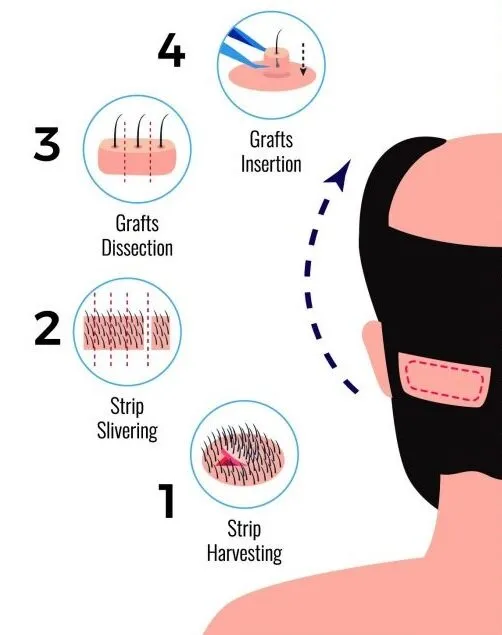
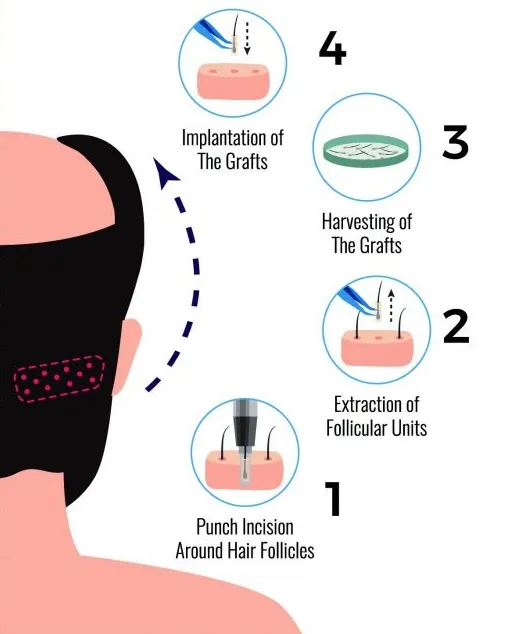
| How donor hair is harvested | Each follicle is punched out individually from the donor area using a fine tool. Approximately every fifth follicle is extracted, so the donor area remains visually full. | A thin strip of scalp is removed from the donor area, and individual follicles are dissected from this strip under microscope. |
| Scar on the back of head | Tiny, dot-like scars spread across the donor area. Not visible even with very short hair. | A thin linear scar across the back of the scalp. Hidden under hair of normal length, can be visible with very short haircuts (less than 4mm). |
| Recovery | Faster. Most patients are back to office in 3 to 5 days. | Slightly longer. Most patients are back to office in 7 to 10 days. Stitches removed at day 10. |
| Grafts per session | Typically 1,500 to 3,000 in one session. | Up to 3,000 to 4,000 in one session, sometimes more. |
| Best suited to | Patients who want to keep their hair short, want the fastest recovery, or have only mild to moderate hair loss. | Patients with more extensive hair loss who need a larger number of grafts in fewer sessions, and who wear hair long enough to cover the linear scar. |
| Procedure time | 4 to 8 hours, sometimes split across two days for larger sessions. | 4 to 6 hours typically. |
Hair transplant is sometimes performed by trichologists or technician-led teams. It is also performed by qualified plastic surgeons in hospital theatres. Both produce results in different settings, but the difference is not cosmetic, it is clinical.
Hairline design is a plastic surgery skill. Where the hairline begins, the natural irregularity that makes it look unposed, and the angle each follicle is placed at, are decisions made by surgical eye and aesthetic judgement, not by a graft-counting algorithm.
Donor area preservation is a surgical decision. Removing every fifth follicle (rather than clearing the area) keeps the back of your scalp looking full long term. This is the kind of detail learned across many surgical procedures, not just hair work.
Hospital setting matters when something needs attention. Allergic reaction, vasovagal episode, unusual bleeding, or anaesthesia issue. These are uncommon, but if they happen, full hospital theatre support is the right place to be.
Plastic surgery training brings the same precision used in facial reconstruction, microsurgery, and aesthetic work. That precision goes into every follicle placement.
Whether FUE or FUT, the procedure follows a similar arc. Local anaesthesia, donor harvest, recipient site creation, follicle placement, recovery. Performed across 4 to 8 hours in a single day.
Local anaesthesia is administered to the scalp. You stay awake but feel nothing in the area. Most patients use the time to watch a film or listen to music.
In FUE, individual follicles are punched out from the donor area one by one. In FUT, a thin strip of scalp is removed and follicles dissected from it under microscope.
The harvested follicles are kept in a special solution that preserves their viability.
Tiny incisions are made in the recipient area, at precise angles to match natural hair growth direction. This is the step where hairline design and aesthetic judgement matter most.
Follicles are placed into the incisions, one at a time. A single session typically transplants 1,500 to 3,000 grafts.
The donor area is dressed (and stitched, in FUT). You receive prescribed medication and a clear written aftercare plan, and you go home the same day.


Lie down straight with one pillow. Saline spray to the area hourly for the first 7 days to keep the grafts moist. Painkillers, anti-inflammatory medication, and antibiotics as prescribed for 3 to 5 days. Donor area dressing opened at 48 hours, cleaned with antiseptic for 5 days. Avoid touching or rubbing the grafts, bending forward, vigorous head movement, and direct sunlight. Most FUE patients return to a desk job from day 5.

After 2 to 3 weeks, the transplanted hair shafts may fall out. This is normal and expected, not a sign of failure. The underlying follicles are healthy and growing beneath the skin. Gentle hair washing with mild shampoo from day 7 onwards. FUT stitches removed at day 10.

The new hair begins to emerge from the follicles, initially fine and pale. This is the patience phase. Most patients see early visible growth by month 3.
Hair gets thicker, denser, and looks increasingly natural month by month. Full final result is appreciable by 9 to 12 months. The transplanted hair grows for the rest of your life and can be cut, styled, dyed, and treated like the rest of your hair.
Hair transplant is often described as minimally invasive, and it is. But the decisions made during it, hairline design, donor preservation, follicle angle, recipient site spacing, are surgical decisions. They are best made by a qualified plastic surgeon trained in the precision work that aesthetic surgery demands.
A fully accredited tertiary care hospital with sterile theatres and full medical support. Even a same-day procedure deserves a hospital setting.
Performed personally by Dr. Vasu. The same hands that work on aesthetic facial surgery, microsurgery, and reconstruction also perform your hair transplant.
Dr. Rajesh Vasu has 30+ years of clinical experience and 5,000+ procedures performed. He is a member of ISAPS, internationally fellowship trained in aesthetic surgery and in hair transplantation at the Knudsen Clinic in Sydney.
Hair transplant cost in Hyderabad depends mainly on three things: the number of grafts needed (which depends on the area being covered and your hair loss grade), the technique chosen (FUE is slightly more time-intensive than FUT), and whether the procedure is done in one session or split across two.
Dr. Vasu provides a full written treatment plan with the cost broken down before anything is scheduled. Surgeon, theatre, anaesthesia, medications, follow-ups, all included. No hidden charges.
For NRI and international patients, hair transplant in Hyderabad delivers internationally trained surgical expertise at a meaningful fraction of the cost of the same procedure in the US, UK, or Gulf.
Real patients. Real repairs. All photographs published with written consent.

Patient 1 · Female, 34 3 months post

Patient 2 · Female, 34 3 months post

Patient 3 · Female, 34 3 months post
Individual results vary. Photographs are representative, not guaranteed outcomes. Consultation required to assess suitability.
There is no fixed age. The right time is when your hair loss pattern has stabilised (usually after 25 to 30) and the donor area on the back of your scalp still has good density. Getting a transplant too young, while the loss pattern is still actively progressing, can look unnatural over time as the surrounding hair continues to thin. Dr. Vasu helps you decide honestly whether now is the right time or if waiting makes sense.
The procedure itself takes 4 to 8 hours, depending on graft count. You go home the same day. Most patients are back to a desk job within 5 to 7 days. The shedding phase happens in weeks 2 to 4 (normal, the follicles are safe). Real growth begins around month 3, and the full final result is visible at 9 to 12 months.
FUE is best for patients who want to keep their hair short, want the fastest recovery, or have mild to moderate hair loss. FUT is better for patients who need a larger number of grafts in fewer sessions, and who wear hair long enough to hide the linear scar at the back of the scalp. The decision is made during consultation after Dr. Vasu examines your donor area, hair loss pattern, and lifestyle.
Under local anaesthesia, you feel nothing in the scalp during the surgery itself. The only mildly uncomfortable part is the anaesthetic injections at the very beginning, lasting a few minutes. Afterwards, soreness is mild (typically a 2 or 3 out of 10) and easily managed with prescribed medication.
Yes, in qualified hands and in a proper setting. Possible risks include mild swelling, temporary numbness, scarring (a linear scar in FUT, dot scars in FUE), and rarely infection. Performed by a qualified plastic surgeon in a hospital theatre, the procedure has an excellent safety record.
Yes, when the procedure is done well. The key to natural-looking results is hairline design, follicle angle at placement, and irregular natural-pattern spacing. Modern technique avoids the ‘pluggy’ look of older transplants. The transplanted hair grows like normal hair, and can be cut, styled, and treated normally.
Sometimes. Patients with higher grades of hair loss (Norwood 4 to 7) often benefit from a second session 6 to 12 months after the first, to add more density or cover additional areas. A single session can typically cover hair loss grades up to 3 or 4. Dr. Vasu tells you honestly during consultation whether one session is enough for your case.
Yes. The hair follicles transplanted from the donor area are genetically resistant to going bald, so they continue to grow for the rest of your life. Your existing non-transplanted hair may continue to thin with age, and Dr. Vasu may recommend medication (minoxidil or finasteride) to slow that ongoing loss.
Yes, after the first year. Once the hair has fully grown in (by 9 to 12 months), it can be cut, styled with sprays/gels/mousses, dyed, blow dried, or treated like the rest of your hair. Before this period, gentle handling is recommended.
The scalp is the most common, but the same technique can be applied to eyebrows, eyelashes, beard, moustache, and sideburns. Dr. Vasu does all of these and the consultation tells you what suits your case.
If you are considering a hair transplant, the most important step is the consultation. Dr. Vasu examines your scalp, assesses your donor area, discusses the technique (FUE or FUT) that suits your case, and gives you an honest expectation of the result. The conversation is private, unrushed and discuss about outcome before you decide. No pressure to proceed.