
Breast lift surgery, medically known as mastopexy, lifts and reshapes sagging breasts to make them firmer, rounder, and naturally higher on the chest. It is the right answer when pregnancy, breastfeeding, weight changes, or simply time have left the breasts lower and flatter than they used to be. The right surgical technique depends on how much lift is needed. Performed personally by Dr. Rajesh Vasu, plastic surgeon, at Apollo Hospitals, Financial District.
2 to 3 hours
General anaesthesia
7 to 10 days off work
Long-lasting, typically 10 to 15 years
It is important to be clear: a breast lift fixes shape and position, not volume. If you want both lift and more volume, the procedure is combined with an implant or with fat grafting. If you want both lift and less volume, it is combined with a breast reduction. Each path is honest and Dr. Vasu helps you choose based on what you actually want.
Most patients researching breast lift surgery want to know why their breasts have changed. The honest answer is that several factors contribute, and most of them are beyond your control.
Sagging is not the same for everyone. Some patients have mild changes that bother them visually. Others have significant ptosis that affects daily comfort, bra fit, and confidence. Breast lift surgery is genuinely worth considering when you recognise yourself in the situations below.
Understanding how the surgery works takes the fear out of it. Here is what actually happens, in plain terms.
If you are planning to have more children, it is usually better to wait until your family is complete. Pregnancy after a lift can stretch the breasts again and undo part of the result.
If your weight is not yet stable, focus on reaching a stable weight first. Significant changes after the surgery can compromise the result.
If the sagging is very mild and the skin still has good elasticity, non-surgical options like HIFU, Morpheus8, or thread lifts may be enough for now.
If your real concern is volume loss rather than sagging, a breast augmentation alone (with implants or fat grafting) may suit you better than a lift.
Patients often ask whether breast sagging can be addressed without surgery. The honest answer depends on how much sagging there is.
For real, established sagging (where the nipple sits at or below the level of the breast crease), surgery is the only reliable answer. This is what a breast lift, sometimes combined with an implant or fat grafting, is designed for. The result is real, lasting, and consistent.
For mild skin laxity or very early changes, non-surgical options exist. Patients should know what they are, what they do, and what they realistically achieve.
Not every breast lift is the same operation. The technique used depends on the degree of sagging, measured in grades of ptosis (Grade 1 is mild, Grade 3 is significant). Dr. Vasu examines you and recommends the technique that matches your case honestly. Six possible techniques, each suited to a specific degree of change:
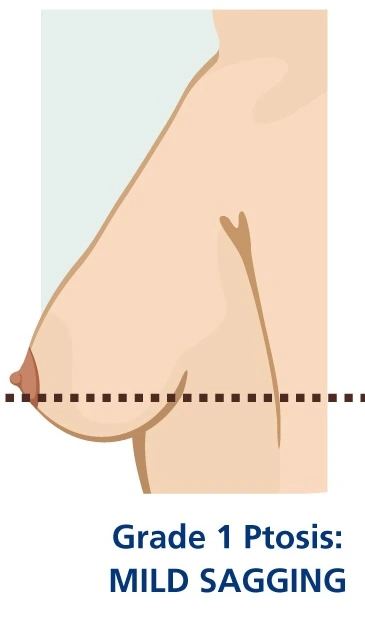
Managed with a breast augmentation alone, or with a small Periareolar lift (also known as a Crescent or Doughnut lift). For patients with very mild sagging where minimal correction is needed.

A small piece of skin is removed at the top of the areola. The smallest, simplest technique, reserved for very minimal sagging.
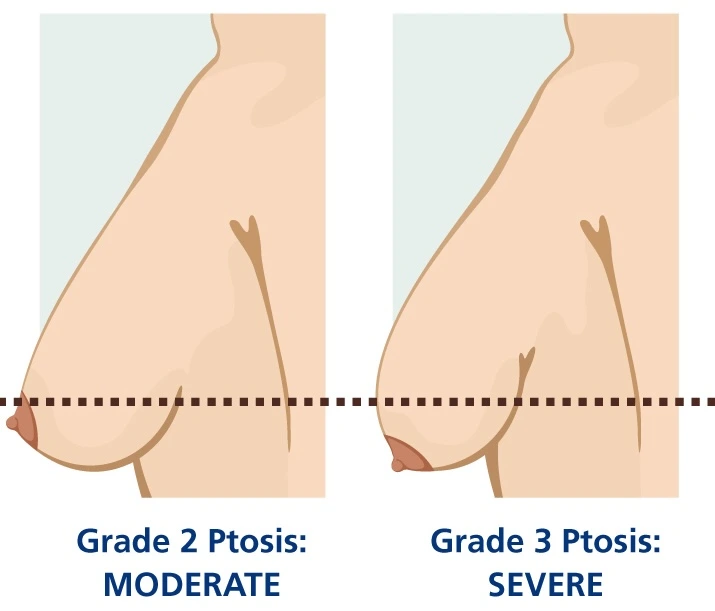
Requires a Lollipop lift or Anchor lift. In patients who also want increased volume, simultaneous augmentation with an implant or fat grafting can be combined with the lift.

A doughnut-shaped piece of skin is removed around the areola, and the surrounding skin sutured in a purse-string manner. Suitable for mild sagging, leaves a scar only around the areola.

An incision is made from the breast crease up to and around the areola, in a lollipop shape. Suitable for low hanging breasts or moderate ptosis. Leaves a fine vertical scar.

The most comprehensive technique. Adds a horizontal incision along the breast crease to the lollipop incision. Suitable for severe sagging where significant skin must be removed.
Once you decide to have a breast lift, the next decision is what to do about volume. A pure lift reshapes what you already have. If you also want more volume, an implant or fat grafting is added. If you do not want any foreign material, an auto-augmentation can be performed instead.
Lift only. Best for patients happy with their current breast size but unhappy with how they sit. Cup size will not change significantly because only excess skin is removed. The breasts simply look perkier and more youthful.
Lift plus implant. Best for patients who have lost volume after pregnancy or weight changes and want both lifting and a fuller, larger shape. Cup size increases proportionate to the implant volume (roughly one cup size for every 200 grams of implant added).
Auto-augmentation (lift without implants). Best for patients with sagging breasts who want a more shapely upper pole without any foreign material. The lower-pole breast tissue is rearranged into the upper pole during the lift, giving very good fullness using only your own tissue.
Breast lift surgery typically takes two to three hours, performed under general anaesthesia at Apollo Hospitals. The steps below describe the standard approach. Dr. Vasu adapts the technique based on your degree of ptosis and whether implants or auto-augmentation is involved.
Dr. Vasu examines your breasts and assesses the degree of ptosis, breast volume, skin quality, areola size, asymmetry, and the position of the nipple relative to the breast crease. He recommends the right technique honestly and discusses whether you also need volume changes.
General anaesthesia, given by a qualified anaesthetist in an Apollo theatre. You feel nothing during the procedure.
The chosen lift technique is performed, with implant or auto-augmentation added if planned. Symmetry, nipple position, and shape are checked carefully before closing.
Most patients are discharged the same evening. You leave wearing a surgical bra, with prescribed medication and a clear written recovery plan.


Soreness, bruising, and swelling in the operated areas are normal for the first week. Pain is well controlled with prescribed medication. Scar reduction creams and moisturisers are prescribed to keep scars supple. Sleep on your back, not face down or on your tummy.

You can go back to a sedentary desk job in 7 to 10 days. Avoid raising your arms above 30 degrees for the first 2 weeks. Surgical bra continues 24/7

Lymphatic massages begin in the second week and continue for about 6 weeks. They help healing, soften the skin, reduce lumps and bumps in the breast. Supportive (not underwired) bra is worn 24/7 for 4 to 6 weeks. Avoid lifting weights beyond 3 kg and avoid exercise.
Cleared for gym, exercise, heavy lifting, and full activity at around 6 to 8 weeks. Initially the breasts may appear lifted a little high; they settle into their natural shape over this period.
The final shape is appreciable. Scars continue to fade over the following 12 to 18 months with consistent use of scar care.
Patients are often relieved to learn that breast lift pain is more manageable than they feared.
Most patients describe the first 2 to 3 days as a 4 to 5 out of 10, mostly a tight, sore feeling rather than sharp pain. By the end of the first week, the soreness eases to a 2 or 3, and many patients are off pain medication. By two weeks most patients feel comfortable and are back to desk work.
The tightness comes from the rearranged tissue and the stretched skin settling into its new position. It loosens over a few weeks. Pain is well controlled with prescribed medication throughout.
It is a real surgery, but the recovery is meaningfully easier than larger procedures like a tummy tuck. Most patients say afterwards that it was easier than they expected.
The success of a breast lift depends almost entirely on choosing the right technique for the right patient. Choose too small a lift for too much sagging and the patient is disappointed within months. Choose too aggressive a technique for mild sagging and the patient is left with unnecessary scars. The judgement to match the technique to the patient is the work of an experienced plastic surgeon, refined across thousands of cases.
Performed in a fully accredited tertiary care hospital with full anaesthesia support, sterile theatres, and advanced monitoring. The safety infrastructure that surgery of this length and depth calls for.
Performed personally by Dr. Vasu, with plastic surgery technique applied to every lift, deep-layer repositioning, hidden incisions, and the conservative judgement that produces a natural result, refined over 30 years.
Dr. Rajesh Vasu has 30+ years of clinical experience and 5,000+ procedures performed. He is a member of ISAPS, internationally trained in aesthetic surgery at one of Europe’s most respected institutes.
Breast lift cost in Hyderabad depends mainly on three things: which lift technique your case needs (smaller lifts cost less than full anchor lifts), whether implants or fat grafting are added for volume, and the complexity of any asymmetry correction needed.
Dr. Vasu provides a full written treatment plan with the cost broken down before anything is scheduled. Surgeon, hospital, anaesthesia, surgical bra, follow-ups, all included. No hidden charges.
For NRI and international patients, breast lift surgery in Hyderabad delivers internationally trained surgical expertise at a meaningful fraction of the cost of the same procedure abroad.
Real patients. Real repairs. All photographs published with written consent.

Patient 1 · Female, 34 3 months post
Patient 2 · Female, 34 3 months post
Patient 3 · Female, 34 3 months post
Individual results vary. Photographs are representative, not guaranteed outcomes. Consultation required to assess suitability.
Breast lift is usually a day care surgery. Your surgery is scheduled in the morning and you are discharged by evening or night on the same day.
Most patients go back to a sedentary desk job in 7 to 10 days. Work involving heavy lifting or arm-raising should wait until 6 to 8 weeks.
Most patients describe the first 2 to 3 days as a 4 to 5 out of 10, more tight and sore than sharply painful. By the end of the first week soreness eases to a 2 or 3 and many patients are off pain medication. By two weeks most patients are comfortable. Pain is well controlled with prescribed medication.
For mild skin laxity or very early changes, non-surgical options like HIFU, RF microneedling (Morpheus8), or thread lifts can help with skin tightening and modest improvement. For real, established sagging where the nipple sits at or below the breast crease, surgery is the only reliable answer. A consultation tells you honestly which category you fall in.
Yes. For women who have sagging breasts and want a more shapely result without implants, a procedure called auto-augmentation is performed. The lower-pole breast tissue is rearranged into the upper pole during the lift, giving very good fullness using only your own tissue.
Crescent and Doughnut lifts usually don’t leave a visible scar. Lollipop and Anchor lifts leave a fine-line scar on the underside of the breast and around the areola. With the scar modulation protocol followed in the postoperative period (scar reduction creams, massage, silicone gel sheets), these scars become barely visible over 12 to 18 months.
Most patients need only one lift in their lifetime. The results hold well for typically 10 to 15 years. However, the breasts continue to age with the rest of the body, so some gradual change over time is normal.
Yes, gradually, because the breasts age with the rest of the body. The lift gives back many years of youthful shape. Significant weight changes, pregnancy, or breastfeeding after the surgery can shorten how long the result holds. With stable weight, the result lasts the longest.
In case of a lift alone, the cup size does not change much because only excess skin is removed. The breasts simply look perkier and more curved. In case of a lift combined with an implant, the cup size increases proportionate to your implant volume, roughly one cup size for every 200 grams of implant added.
No. The nipple-areola complex stays attached throughout the surgery, with its blood supply preserved. It is simply repositioned to a higher, more natural location on the chest. Nipple sensation is preserved in the vast majority of patients, although temporary altered sensation can occur in the early weeks.
As with any surgery, possible risks include bleeding and infection (rare), altered nipple sensation (usually temporary), slight asymmetry, and wound healing problems (more common in patients with diabetes, smokers, or significant obesity). Seroma (fluid collection) and haematoma (blood collection) can occur and usually resolve on their own, occasionally needing aspiration. Dr. Vasu reviews all risks honestly in your consultation.
You can resume exercise and gym after 6 to 8 weeks once Dr. Vasu has cleared you. Heavy lifting, contact sport, and chest exercises should wait until this point. Returning too early risks bleeding, fluid collection, and damage to the new shape.
Yes. The most common combination is a lift with breast implants (lift plus augmentation) or with fat grafting. It can also be combined with a breast reduction, or with body procedures like a tummy tuck as part of a mommy makeover after pregnancy. Dr. Vasu advises what is safe to combine in one session based on overall surgery time and your health.
There is no fixed best age. The right time is when the sagging is established (skin has stretched beyond its elastic limit), your family is complete (or you are sure you will not have more children, since pregnancy after a lift can stretch the breasts again), and your weight is stable. Many patients have it in their 30s, 40s, or 50s, and good candidates exist across all these ages.
If you are considering a breast lift, the most important step is the consultation, where Dr. Vasu can tell you honestly which technique suits your case, whether you would benefit from adding an implant or auto-augmentation, what the realistic result will look like, and what your recovery would involve. A 15 to 20 minute consultation at Apollo Hospitals or virtually is the simplest place to start. No pressure to proceed. Just honest, expert advice.