Rhinoplasty in Hyderabad

Rhinoplasty (commonly called a nose job) is plastic surgery to reshape the bone and cartilage of the nose — for cosmetic refinement, breathing correction, or both.

PROCEDURE TIME

30 minutes

ANAESTHESIA

Local only

SUTURES REMOVED

7 to 10 days

RE-PIERCING

After 6–8 weeks

what is rhinoplasty

What rhinoplasty actually does​

Rhinoplasty surgery can change the bridge by reducing a hump, straightening a deviation, or building up a depressed area. It can refine the tip by narrowing a bulbous shape or lifting a drooping one. It can address the nostrils by reducing flaring or correcting asymmetry. It can also correct a deviated septum and improve airflow at the same time, in the same operation.

What a good rhinoplasty does not do is give you someone else’s nose. The aim is a result that fits your face, your bone structure, your skin, your features, so that people notice you looking better without being able to put their finger on why. People should notice you, not your nose. That is the entire goal.

Types of Rhinoplasty

Types of Rhinoplasty procedures

There are two surgical approaches to rhinoplasty. At consultation, depending on your concern and how your nose has grown, we'll recommend the one that fits you.

01

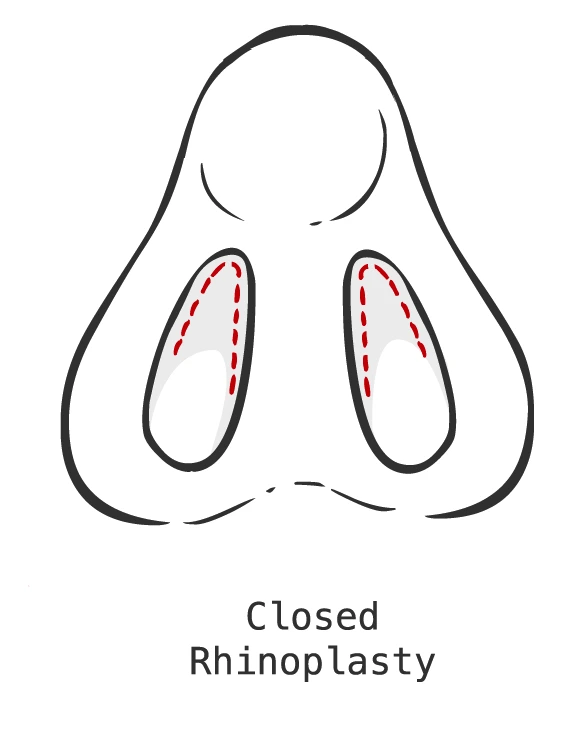
Closed rhinoplasty

For minor nose correction. The nose is approached via internal incisions and no external scars are visible. Corrections like augmentation of bridge, hump reduction and narrowing of bony pyramid can be performed through this approach. Recovery tends to be a little faster and external swelling settles sooner.

02

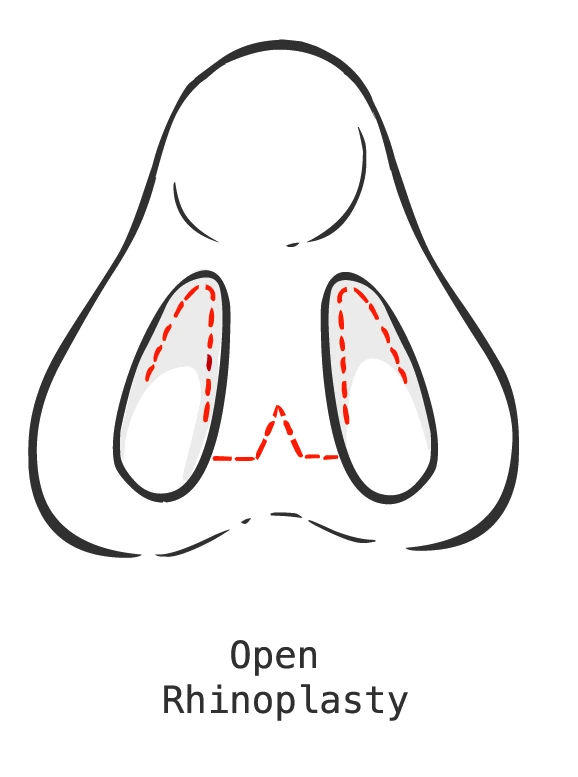
Open rhinoplasty

For comprehensive nose correction where changes are required in multiple areas. A small external incision is made to connect the internal incisions and enables access to all areas of the nose. The skin is separated from the underlying structures. The bone and cartilage are sculpted, reshaped and the overlying skin is redraped on the sculpted framework.

The approach is chosen based on your specific anatomy and what you want changed — not on a default preference. The decision is explained, with reasoning, at consultation.

Eligibility

Who is eligible for Rhinoplasty?

Most patients arriving for rhinoplasty are healthy adults over 18 who have lived with one or more of the following concerns long enough to want them addressed properly:

PROFILE CONCERNS

A nose that feels too large for your face

When the nose dominates facial features instead of complementing them, rhinoplasty can improve balance and harmony while preserving your natural character.
BRIDGE REFINEMENT

A prominent hump or a low bridge

Whether the bridge appears overly projected or lacks definition, rhinoplasty can create a smoother, more proportionate profile tailored to your facial structure.
WIDTH & SHAPE

A wide nose or flaring nostrils

Excess width can make the nose appear disproportionate. Surgical refinement can narrow the bridge, nostrils, or overall nasal width for improved facial harmony.
TIP DEFINITION

A bulbous or undefined nasal tip

Refining the nasal tip can create better definition and elegance while maintaining a natural appearance that complements your features.
STRUCTURAL CORRECTION

A crooked or deviated nose

Trauma, genetics, or developmental changes can affect nasal alignment. Rhinoplasty can improve symmetry and restore structural balance.
FUNCTIONAL IMPROVEMENT

A nose that looks fine but doesn't breathe well

Breathing difficulties caused by a deviated septum or internal nasal obstruction can often be corrected alongside cosmetic refinement.
REVISION RHINOPLASTY

An earlier rhinoplasty you weren't happy with

Revision rhinoplasty is designed for patients seeking correction of aesthetic concerns, functional issues, or unsatisfactory results from a previous nasal surgery.

If you have any of these concerns, a consultation will give you a clarity on what can be achievable for your nose bone structure.

Common concerns and procress

Common concerns patients come with for rhinoplasty

Most patients considering rhinoplasty are not looking for a completely different face. They usually come in with one or two specific concerns that have bothered them for years — sometimes in photographs, sometimes while breathing, sometimes after an earlier surgery that never felt quite right.

Two types of Rhinoplasty procedures

01

The consultation

A consultation runs about 30 to 45 minutes, in person or virtual if you're travelling from another city or country. We'll talk through what you'd like to change, what's realistic for you, which approach we'd recommend, and what recovery actually looks like day by day. You'll leave knowing what the procedure would involve and what it would cost, in writing. There's no pressure to book on the day. Most people take the conversation home, sit with it for a few weeks, and come back when they're ready.

02

Pre-operative planning

Once you've decided to go ahead, we spend time preparing you properly. Photographs are taken from standardised angles so we can plan the surgery precisely. Basic blood work and a fitness clearance are organised. If your rhinoplasty includes breathing correction, that workup happens here too. We also talk you through what to expect on the day of surgery, what to bring with you, who should come along, and how to prepare your home for the first week of recovery. Small things matter, like which pillow to sleep on, what to keep in the fridge, who to call if something feels off. By the time surgery day arrives, you should feel ready, not anxious. Surgery is scheduled when you're ready, not before.

03

The surgery

Performed in the hospital operating theatre under general anaesthesia or deep sedation, depending on complexity. Procedure time is typically 2 to 3 hours. Most patients are discharged the same day. Complex or revision cases may need an overnight stay, depending on how you're recovering immediately afterwards.

04

Immediate post-operative

You wake up with a small splint on the bridge of the nose and, in some cases, a soft pack inside the nostrils. The pack comes out at 1 to 2 days; the splint comes off at 5 to 7 days. Visible bruising around the eyes is normal for the first 7 to 10 days. You can manage the recovery from home, most of the visible swelling is gone by week 2.

recovery

What recovery actually looks like

First week after surgery

You may have an intranasal pack, which will be removed in 1 or 2 days. The external nasal splint may be taken off in 5-7 days. The very fine sutures on the lower side of the nose, at the junction of the lip may be taken out on the 5th day post operation. You may be advised to apply nasal drops for a period of 3-5 days

Week 2 to 4

Visible bruising fully resolves. Return to a sedentary desk job is comfortable from week 2. No bending, no contact sports, no gym, no strenuous activity. No smoking for 3 weeks minimum, all of these can slow the healing and prolongs swelling.

Weeks 4 to 6

You're back to normal activity, including light exercise, once cleared. The nose looks like itself again to other people, though you may still notice fine residual swelling that they won't.

Week 6 to 8

This is when most patients first feel like their result is showing. The shape is settling, the swelling has come down significantly, and photographs from this point onward genuinely reflect the new nose

Full recovery

The final shape has come through and the result you'll keep is now visible. If open rhinoplasty was performed, the scar has faded into the natural curve under the nose and is barely noticeable.

WHY DR. VASU

About Dr. Rajesh Vasu

Rhinoplasty is among the most technically demanding procedures in plastic surgery. A few millimetres of difference in technique produces a substantially different result that you live with for life. So it’s worth knowing who you’re trusting with the decision.

Training

MS in General Surgery from AIIMS New Delhi. MCh in Plastic Surgery from NIMS Hyderabad. Fellowship in Aesthetic Surgery at the Dr. Javier de Benito Institute, Barcelona. Fellowship in Hair Transplantation at Knudsen Clinic, Sydney. Specialist training in face and body aesthetic surgery across two continents.

Practice

Rhinoplasty has been a defining part of Dr. Vasu’s work for over 30 years. Among the thousands of procedures performed personally across face, body, and reconstructive surgery, rhinoplasty is the one he is sought out for, the one patients travel for, the one fellow surgeons refer to him.He sees primary rhinoplasty cases, where this is a patient’s first surgery, and revision rhinoplasty cases, where someone is unhappy with a result from another clinic and wants it corrected properly. The second kind is technically harder and Dr. Vasu takes on those cases regularly.

Approach

A consultation here unfolds in its own time. We listen to what’s brought you in. We understand the change you’re hoping for. We examine, explain what’s possible, and walk you through how the surgery would actually work for you. If you decide to go ahead, our team prepares you properly, including financial counselling so there are no surprises, and gets you ready for the day of surgery.

This is the approach because the aim has always been the same: results that look like the patient, just on their best day.

RESULTS

Before. After.

Real patients. Real repairs. All photographs published with written consent.

Patient 1 · Female, 34                                             3 months post

Patient 2 · Female, 34                                              3 months post

Patient 3 · Female, 34                                              3 months post

Individual results vary. Photographs are representative, not guaranteed outcomes. Consultation required to assess suitability.

RECOGNISED BY

Outlook India

India Today

ISAPS

APTOS Trainer

IMCAS Paris

FREQUENTLY ASKED

Questions, answered honestly.

What is the right age for rhinoplasty?

For cosmetic reasons, rhinoplasty should not be performed before 18 years of age  the nose’s growth centres need to complete development first. In cases of severe disfigurement from injury or birth defect, surgery may be performed earlier to restore function or form, with care taken around the growth centres.

Will my nose look natural after surgery?

Yes, that is the entire goal. The aim is a nose that looks like it has always been yours — refined, balanced, in proportion with your face — not a nose that obviously announces it has been operated on. Each element is shaped precisely, then blended so the overall face stays unmistakably you.

Will rhinoplasty improve my breathing?

In most cases, yes — significantly. Where breathing has been compromised by internal nasal valve collapse, deviated septum, or enlarged turbinates, those issues are addressed during the same procedure. A short period of 10 to 14 days of stuffiness from post-surgical swelling is normal and resolves on its own.

What is the difference between open and closed rhinoplasty?

Closed rhinoplasty is performed entirely through incisions inside the nose — no visible external scar — and is suitable for minor reshaping. Open rhinoplasty uses a small additional incision under the nose, giving full access to the nasal framework — required for comprehensive reshaping involving the tip and multiple areas. The approach is chosen based on your specific anatomy and goals, and is explained with reasoning at consultation.

How long is the hospital stay?

Rhinoplasty is a day-care procedure in most cases — you go home the same day. For more complex or revision cases, an overnight stay may be advised. This is confirmed at consultation, not on the day of surgery.

When can I get back to work?

For a sedentary job and a minor correction: 5 to 7 days. For a physically active job, or a more complex rhinoplasty: 2 to 3 weeks of restricted activity, ideally working from home. The external splint comes off in 5 to 7 days; the visible swelling settles enough to be unnoticeable in social settings by week 2 to 3.

Will there be a visible scar?

With closed rhinoplasty, the scars are entirely inside the nose and not visible. With open rhinoplasty, a small scar lies on the underside of the nose, hidden in the natural curve between the nostrils, and is barely visible even on close inspection. Either way, no scar is visible at conversational distance.

What are the risks?

As with any surgery: bleeding, infection, temporary bruising, numbness, scarring in some patients, and the possibility of needing minor revision work. The likelihood of these is significantly reduced when the procedure is performed by a board-certified plastic surgeon in a hospital setting with full sterile protocols. Your specific risk profile is discussed honestly at consultation — including any factors specific to your anatomy or health history.

I had a rhinoplasty before and I'm unhappy with the result. Can it be fixed?

Often, yes — though the answer depends on what was done before, your current anatomy, and what you want changed. Some revisions are minor touch-ups; others require comprehensive reconstruction of the nasal framework. Revision rhinoplasty is technically more demanding than a first-time procedure and the realistic outcome may be different from what you would have achieved with a good first surgery. Your prior surgery records are reviewed and you receive an honest assessment of what is and isn’t achievable.

When is the best time to consider revision after a poor result?

Wait 12 to 18 months from the original surgery. The nose continues to refine for up to a year, and revising too early often produces a result worse than waiting. The exception: obvious post-surgical deformities can be addressed at 4 to 6 months, once acute inflammation has settled. The advice is to examine first, recommend honestly, and only operate when revision is genuinely indicated.

How much does rhinoplasty cost in Hyderabad?

Cost varies based on complexity — closed versus open, primary versus revision, whether breathing correction is included. A transparent written treatment plan with full cost breakdown is provided after consultation. No pricing is committed before you have been examined in person or virtually, and there are no hidden charges.

Do you treat patients travelling from outside Hyderabad?

Yes — regularly. A meaningful share of rhinoplasty patients travel from Mumbai, Bangalore, Chennai, and internationally. Virtual consultations are available before you book travel. Coordination on scheduling, accommodation guidance, and post-operative follow-up means most patients can complete the procedure and the bulk of the recovery in a single trip.

Talk to Dr. Vasu

Most people who consider rhinoplasty think about it for months, sometimes years, before they’re ready to act. There’s no right timeline and no wrong one. Whatever brings you in, cosmetic or functional or both, we’ll help you understand the right approach for your case, what the results could realistically look like for you, and what the journey from here to there involves.

If you decide to go ahead, our team walks alongside you. That includes financial counselling so the cost side is clear from the start, and emotional preparation in the weeks before surgery, because the mental side of a procedure like this matters as much as the surgical side. You leave the consultation with everything you need to decide in your own time.

Rhinoplasty

Commonly referred to as “nose correction” or “nose job,” is surgery to change the shape of your nose by modifying the bone or cartilage. 

Two types of Rhinoplasty procedures

01

Closed Rhinoplasty

For minor nose correction. The nose is approached via internal incisions and no external scars are visible. Corrections like augmentation of bridge, hump reduction and narrowing of bony pyramid can be performed through this approach.

02

Open Rhinoplasty

For comprehensive nose correction where changes are required in multiple areas. A small external incision is made to connect the internal incisions and enables access to all areas of the nose. The skin is separated from the underlying structures. The bone and cartilage are sculpted, reshaped and the overlying skin is redraped on the sculpted framework.

Who is eligible for Rhinoplasty?

Any Healthy Individual Aged 18 With Any Of The Following Concerns:-

  • Large nose
  • Prominent hump
  • Depressed nasal bridge
  • Wide nose
  • Bulbous nasal tip
  • Flaring of nostrils
  • Crooked/deviated nose

  • Post Operative Care Rhinoplasty

    First week after surgery

    You may have an intranasal pack, which will be removed in 1 or 2 days. The external nasal splint may be taken off in 5-7 days. The very fine sutures on the lower side of the nose, at the junction of the lip may be taken out on the 5th day post operation. You may be advised to apply nasal drops for a period of 3-5 days

    First month after surgery

    Smoking has to be avoided for at least a period of 3 weeks as it can result in poor healing and prolonged swelling. You may be advised to avoid bending forward, play contact sports, gym exercises or any strenuous activities for a period of 6 weeks.

    Full recovery timeline

    You may observe the results immediately after surgery, but you can perceive the final result after 6 weeks. The result of rhinoplasty takes a while to be appealing. Patience is required as the nose settles down over a period of weeks to months For patients with thick, oily skin, the post-op swelling may remain longer and takes 4-6 months time to perceive the result.

    FAQ

    Rhinoplasty for cosmetic reasons should not be performed till 18 years of age as it may affect the growth centres in the nose. However, in case of severe disfigurement due to accidents or birth defects, the surgery is performed to help restore the deformity of growth centres.

    Yes, breathing can be improved significantly in the majority of cases, where internal nasal valves and enlarged turbinates are addressed. However, you may feel some nasal stuffiness for a period of 10-14 days as a result of swelling ,which eventually subsides.

    Rhinoplasty is usually a daycare procedure and you may go back home on the same day of surgery. For patients with complex surgery, overnight stay may be advised. 

    If you have a sedentary job and if you have a minor correction, you may go back to work in 5-7 days. However, if your job involves physical activities or if you had a complex rhinoplasty, you will need to restrict your work to home for 2-3 weeks.

    The goal is to achieve a look which appears as natural and unoperated as possible.  Meticulous care is taken both to shape each individual element precisely, to blend the elements and bring harmony to the overall appearance of the nose.

    The overall goal is to produce a result which appears unoperated but is a significant improvement from the preoperative appearance.

    When closed rhinoplasty is performed, the scars lie inside the nose and won’t be visible at all. When open rhinoplasty is performed, the scars lie on the underside of the nose and are barely visible.

    As with any other surgical procedure, rhinoplasty may be associated with risks like bleeding, infection, temporary bruising, numbness, scarring in some patients and unsatisfactory results. Occasionally, they may require additional minor revision surgery.Very rarely the results may not be up to patient’s expectations.

    The revision of a rhinoplasty can be quite variable and depends entirely upon the patient’s wishes ,existing anatomy and the procedure which was done before. Sometimes minor touch ups are all that is required and in other cases a major revision of theunderlying nasal structures is necessary. Revision of a rhinoplasty typically is more complex and takes longer than a rhinoplasty performed for the first time and the expectation for what could be reasonably achieved may be lower. During your consultation our team of surgeons will specifically discuss with you what you can and cannot reasonably expect from the revision of your rhinoplasty.

    Each case of rhinoplasty is different; usually the results and appearance will continue to improve over the entire first year. So it’s always as wise decision to wait for 12-18 months before attempting any revision for the unsatisfactory results. However, in patients with obvious post-surgical deformities, better to undergo rhinoplasty once the acute inflammation subsides (usually 4-6months).